Institutional Governance
Decision-Making Bodies and Governance Structure
The University Council is the highest decision-making body of the University. It meets twice each semester, with special meetings convened when necessary. Members include the President, Vice Presidents, faculty, staff, and student representatives, selected in accordance with organizational regulations to ensure inclusive participation and effective university governance.


Risk Analysis and Impact Response
NCCU SWOT Analysis
The University conducts SWOT analysis to assess strengths, weaknesses, opportunities, and threats, informing overall development planning and strategic direction.

Response Strategies
Facing challenges such as declining birth rates and global competition in higher education, the University has identified five response strategies based on SWOT analysis: advancing AI education grounded in the humanities, strengthening bilingual and international learning environments, enhancing diversity in student recruitment, establishing the X Experimental College to promote interdisciplinary exploration, and integrating ESG and SDG policies to build a sustainable governance framework.
Financial Planning
Financial Revenues and Expenditures Overview


Sustainable Investment Strategy
In accordance with Article 14 of the National University Fund Management and Supervision Regulations, NCCU has set the investment ceiling for its university fund at NT$500 million. The University’s Investment Management Team consists of ten internal and external committee members with strong investment management expertise and a solid reputation in the financial sector. This team is responsible for formulating NCCU’s investment guidelines, policies, and asset allocation principles for the following year, which are implemented after review and approval by the University Fund Management Committee.
In response to global trends in sustainable development and governance, NCCU has incorporated ESG (Environmental, Social, and Governance) investment principles into its investment plans and management procedures since 2022. The University prioritizes investment in funds that comply with the “Principles for Review and Supervision of Information Disclosure of Securities Investment Trust Funds with ESG-Related Themes” issued by the Financial Supervisory Commission. Through the evaluation of potential investment targets in terms of sustainability, corporate social responsibility, and corporate governance, NCCU aims to manage long-term risks and obtain stable returns for its university fund.
Beginning in 2023, the university began the process of completely divesting from high-polluting and high-carbon-emitting industries. All university funds are now invested in mutual funds, including domestic firms of which 98.74% disclose sustainability reports. In terms of corporate governance ratings, 40.33% of invested companies were ranked in the top 5%, while 26.79% were ranked between 6% and 20%. The university will continue to improve its sustainable investment strategy, prioritizing investments based on the criteria of the TDCC Environmental, Social, and Governance (ESG) Fund Zone, and gradually implementing new impactful investing strategies.

Digital Innovation
Information Security
In accordance with the Information Security Management Act, the University implements information security and personal data protection frameworks, with ongoing training, risk management, and incident reporting to strengthen campus-wide cybersecurity and data protection.


Digital Transformation
To improve administrative efficiency and service quality, the University established the Administrative Process Digital Transformation Team (DTT) in 2022 to advance administrative digitalization through cross-unit collaboration. In 2024, eight system projects were completed, including online maintenance requests, academic affairs integration, and e-payment services, demonstrating progress in digital transformation.


Digital Instruction
Through “NCCU Digital Knowledge City“, the University integrates high-quality digital resources. In 2024, it offered 12 workshops to strengthen faculty AI applications and digital teaching practices, attracting

Visit NCCU Digital Knowledge City:https://moocs.nccu.edu.tw
Talent Retention and Recruitment
Faculty and Staff Composition (Past Three Years)
Full-time faculty and staff changes

Full-time Faculty and Staff Turnover
近三年新聘(進)、離職(含退休、死亡)教職員工人數平均數分別為139人、133人,2022年及2023年新進較離職教職員工人數多;2024年度新進與離職教職員工人數相當;離退原因多元,如個人生涯規劃、屆齡退休及自願退休等。

Age distribution of full-time faculty and staff

Staff Training, Benefits and Compensation
Faculty and Staff Education and Training
- Professional Training: Programs for supervisors, new hires, and current staff, with in-service training further divided into core competency training and specialized professional training.
- General Education Courses: Courses focused on policy awareness, personal development, and humanistic literacy.
Faculty and Staff Benefits and Compensation


Workplace Diversity and Inclusion
Number of International, Indigenous and Disabled Employees


Number of Male and Female Supervisors

Grievance and Remedy Mechanisms
To safeguard faculty, staff, and labor-based student assistants from improper treatment, the University has established grievance review committees for faculty, staff, and student part-time assistants to handle related complaints. To prevent workplace violence, the University has implemented the NCCU Prevention Plan for Unlawful Infringement in the Execution of Duties, with reporting mechanisms and risk assessments coordinated by the Environmental Health and Safety Division of the Office of General Affairs. Ongoing training and environmental improvements are also carried out to foster a safe and supportive work environment.
For more information:https://sdgs.nccu.edu.tw/組織倫理-2/
Safe and Resilient Campus
Occupational Safety and Health Management Plan
The University has established an Environmental Protection and Occupational Safety Committee and implements an annual Environmental Safety and Health Management Plan. Guided by pollution prevention, hazard control, and continuous improvement, the University complies with regulations, strengthens safety awareness, prevents occupational accidents, and safeguards the health and safety of faculty, staff, and students.

Campus Safety and Disaster Prevention
The University maintains a comprehensive emergency response system, with recent enhancements including:
- Safety Education and Outreach: Conducted campaigns on earthquake evacuation, traffic safety, anti-fraud awareness, and substance abuse prevention through drills, talks, and targeted outreach, in coordination with class and department representatives.
- Campus Safety Incident Monitoring: Regularly compiled and reported campus incidents, with reviews and follow-up actions discussed in joint meetings.
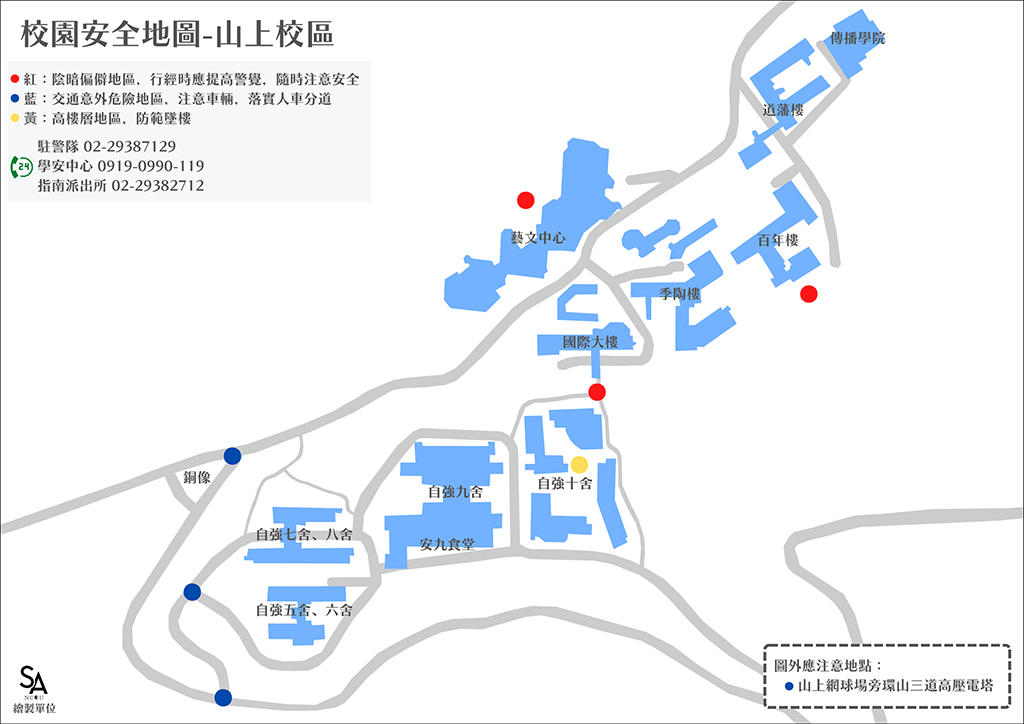
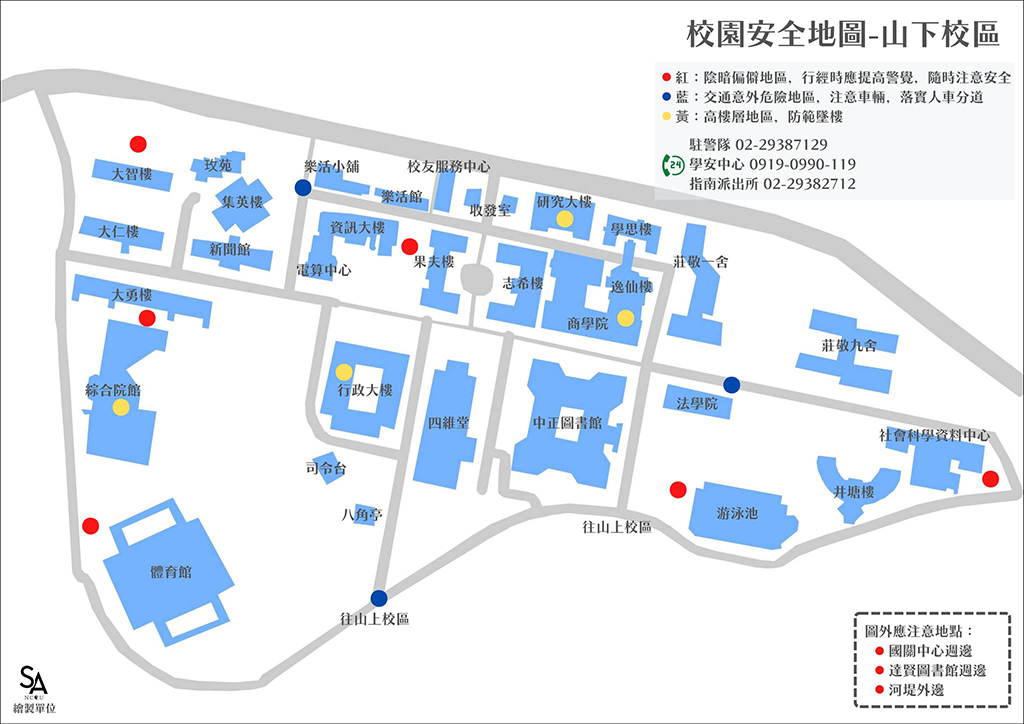
- Disaster Preparedness and Mapping: Developed and published disaster prevention maps for upper and lower campuses based on risk assessments and expert reviews, including evacuation routes, assembly points, and emergency equipment locations.