\ What sustainability initiatives are happening at NCCU? Let’s explore! /

Based on the 2023 NCCU Sustainability Issue Survey, the University’s sustainability working group identified four key sustainability topics of concern to faculty and students. Faculty and students were invited to develop university-funded research proposals to jointly advance a friendly and sustainable campus environment and way of life.
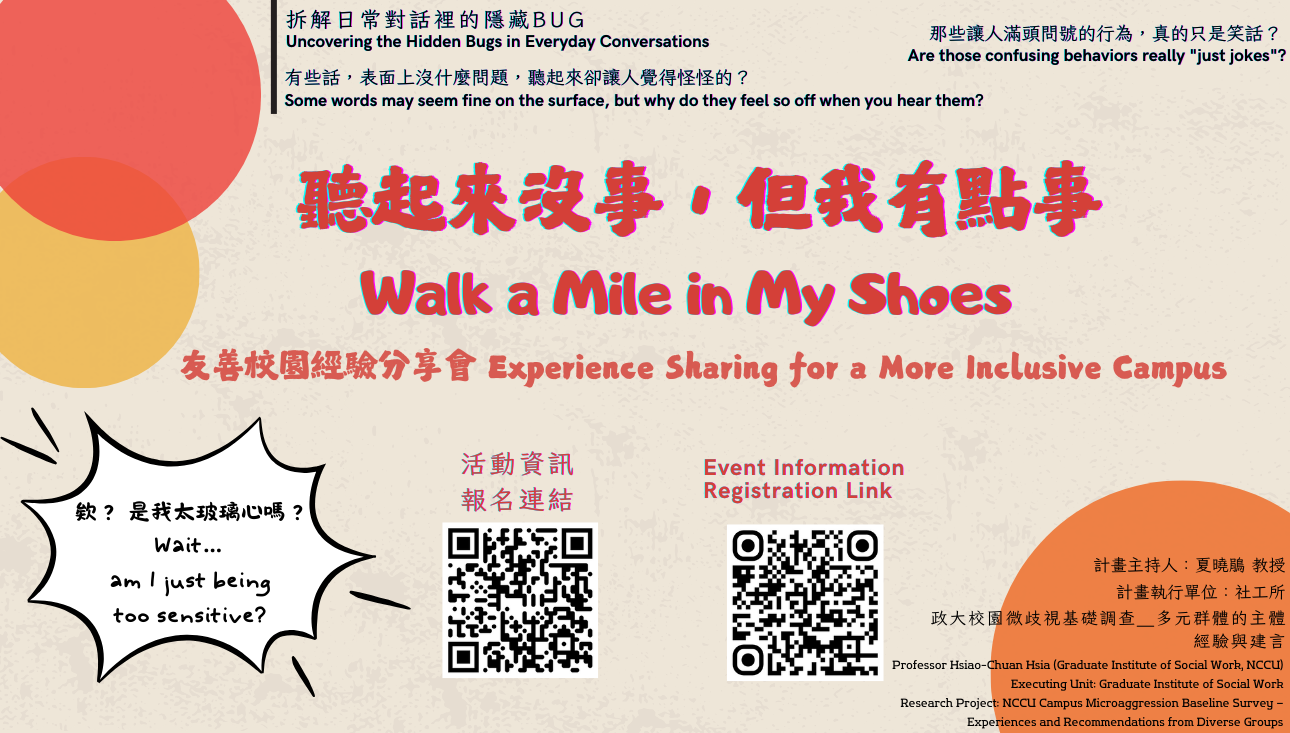
NCCU Microaggression Baseline Study: From the Perspectives of Diverse Groups
Principal Investigator: Prof. Hsia, Hsiao-Chuan, Graduate Institute of Social Work
Implementing Unit: Graduate Institute of Social Work
Background & Objectives
Microaggressions in Multicultural Settings
Microaggressions are common in diverse environments such as campuses and workplaces. They are often subtle and embedded in everyday language or behavior, making them difficult to recognize. Calls for political correctness alone are insufficient to address the issue.
Research Objectives
This project focuses on the lived experiences of individuals who have encountered microaggressions and gathers their recommendations for reducing microaggressions on campus. The aim is to develop empathy-building strategies and foster a more inclusive and supportive campus environment.
Action Plan & Expected Outcomes
- Literature Review:
Compile domestic and international research on microaggressions. - Focus Group Discussions:
Engage diverse groups—such as gender-diverse individuals, Indigenous peoples, new immigrants, international students, ethnic minorities, and persons with disabilities—to understand their experiences and proposed solutions. - Content Analysis:
Identify patterns of microaggressions at NCCU and develop practical strategies to address and reduce them.
Project Outcomes
NCCU Campus Microaggression Baseline Study Final Report
NCCU Circular Economy Experimental Base Project
Principal Investigator:Assoc. Prof. Chang, Yu-Chien
Implementing Unit:Graduate Institute of Technology Management and Intellectual Property
Project Assistants:Wang, Cheng-Hsien (Ph.D. Student, TMIP Institute); Liang, Chia-Meng (Student, Department of Law)
Background & Objectives
Circular Economy Beyond Natural Sciences
Achieving circular economy pathways requires more than engineering solutions for resource recycling. People and society are central to implementation, alongside innovations in business models, public awareness and education, and regulatory frameworks—areas where NCCU holds unique opportunities.
Research Objectives
This project aims to position the NCCU campus as an innovative living lab by developing actionable circular economy solutions for the next 3–5 years. It explores how such solutions can be implemented across teaching, administration, dormitories, and dining services, forming a practical campus circular economy roadmap.
Action Plan & Expected Outcomes
- Literature Review and Case Analysis:Review international studies on quantitative indicators for campus circular economy practices, and develop an evaluation framework and indicators suitable for NCCU.
- Campus Circular Hotspot Mapping:Collaborate with waste management companies, relevant administrative units, academic departments, and student organizations to examine resource use across campus and identify potential circular economy “hotspots.”
- Building Internal and External Circular Networks:Organize collaborative exchange activities involving faculty, staff, students, and external partners—such as alumni engaged in circular economy ventures and EMBA alumni—to jointly explore current practices and innovative solutions for campus circularity.
Project Outcomes
NCCU Mountain and River Affinity Project -Ecological Campus Story Map
Principal Investigator:Prof. Chan, Chin-Fa
Implementing Unit:Department of Land Economics
Background & Objectives
Geographic Advantages of a Mountain- and River-Adjacent Campus
NCCU’s uphill campus covers a large portion of the campus and preserves rich natural ecosystems, generating significant benefits for health, culture, aesthetics, climate regulation, and carbon sequestration.
Following the completion of riverbank revitalization along Zuimeng Creek by the Taipei City Government, how can the University further activate the area’s waterfront features and ecological potential?
Research Objectives
This project aims to reconnect faculty and students with the campus back-hill landscape, integrating NCCU’s strengths in the humanities, social sciences, and natural ecology.
Action Plan & Expected Outcomes
- Applying Geospatial Technologies:Design participatory data-collection mechanisms to support collaborative campus biodiversity surveys.
- Developing the NCCU Ecological Story Map
Create an interactive map combining multimedia content and satellite imagery to encourage closer engagement with nature and enhance ecological conservation awareness. - Advancing Follow-Up Projects and External Funding:
Seek external resources through USR and related programs, and submit proposals to government agencies and sustainability-focused foundations to support holistic back-hill revitalization.
Project Outcomes
To mark its centennial anniversary, NCCU launched the “ Fun Tour of NCCU ” StoryMap—an interactive guide that weaves together campus history, culture, and natural ecology. Through a fictional dialogue between a freshman student and his grandfather, the StoryMap leads users on a journey of memory and discovery, from the cultural landscape of “one mountain, two rivers, five bridges, nine colleges, and ten scenic views” to the vibrant ecosystems of the back-hill area. The narrative approach allows users to better understand NCCU’s history and environmental features.
As a key outcome of the “ NCCU Mountain and River Affinity Project ” , the StoryMap is presented in both Chinese and English. Faculty, students, and the public are warmly invited to explore this mountain- and river-adjacent campus, uncover its historical layers, ecological richness, and sustainability values, and join in safeguarding NCCU’s environment and future.
🔗StoryMap Links:
- Chinese Version|https://arcg.is/uGSi50
- English version|https://arcg.is/1vezLW0
NCCU Campus Energy-Saving Promotion Plan
Principal Investigator:Prof. Lin, Yi-Chun
Implementing Unit:Graduate Institute of National Development
Background & Objectives
Energy Use Behavior as a Key Enabler
The University has progressively implemented energy-saving and carbon reduction strategies—such as equipment upgrades and improved energy efficiency—to reduce electricity consumption. This project complements technical measures by focusing on social solutions, particularly energy use behavior change, through the promotion of the NCCU Energy Conservation Measures.
Research Objectives
The project aims to raise energy-saving awareness and identify barriers to energy conservation from a user perspective, providing evidence-based insights to support policy implementation.
Action Plan & Expected Outcomes
- Outreach and Promotion:
During the University anniversary period, collaborate with student organizations to host interactive booths and incentive-based activities to promote the NCCU Energy Conservation Measures. - Survey Research:
Select three representative campus buildings to conduct surveys on energy use behaviors, identify different types of energy waste hotspots, and develop targeted intervention measures.
Candidate Buildings
General Building: Teaching and research
Chiang Ching-kuo Library: Research and administration
Tzu-Chiang Dormitory: Learning and residential life